
The Greater Toronto Area (GTA) real estate landscape has undergone a significant transformation as we move through 2026. With shifting interest rates, updated government incentives, and a market that has transitioned firmly into buyer’s territory, navigating a home purchase requires more than just a search: it requires data-driven precision.
Whether you are looking for condos for sale in Toronto, exploring townhomes for sale in the GTA, or eyeing luxury homes in Toronto, the questions remain consistent: Is now the right time? Can I afford it? Where is the best value?
In this comprehensive guide, I leverage "The PhD Advantage": my background in analytical research and data-driven insights: to answer the top 15 questions currently dominating Google, Reddit, and social media for GTA home buyers. My goal is to provide you with the clarity needed to make a confident, informed decision in today's complex market.
1. Is now a good time to buy a home in the GTA?
In short: Yes, for those with a long-term horizon.
As of May 2026, the GTA is currently in a "buyer’s market." With a sales-to-new-listings ratio of approximately 36%, inventory levels are healthy, and buyers have significantly more leverage than in previous years. Homes are currently selling at 97–98% of their asking price, meaning the days of aggressive bidding wars are largely behind us.
For buyers, this environment offers the luxury of time. You can now include conditions such as home inspections and financing, which were nearly impossible to secure just a few years ago. If you have stable employment and a down payment ready, the current market allows you to shop without the high-pressure "bully offer" tactics of the past.
2. Will home prices increase or decrease in the remainder of 2026?
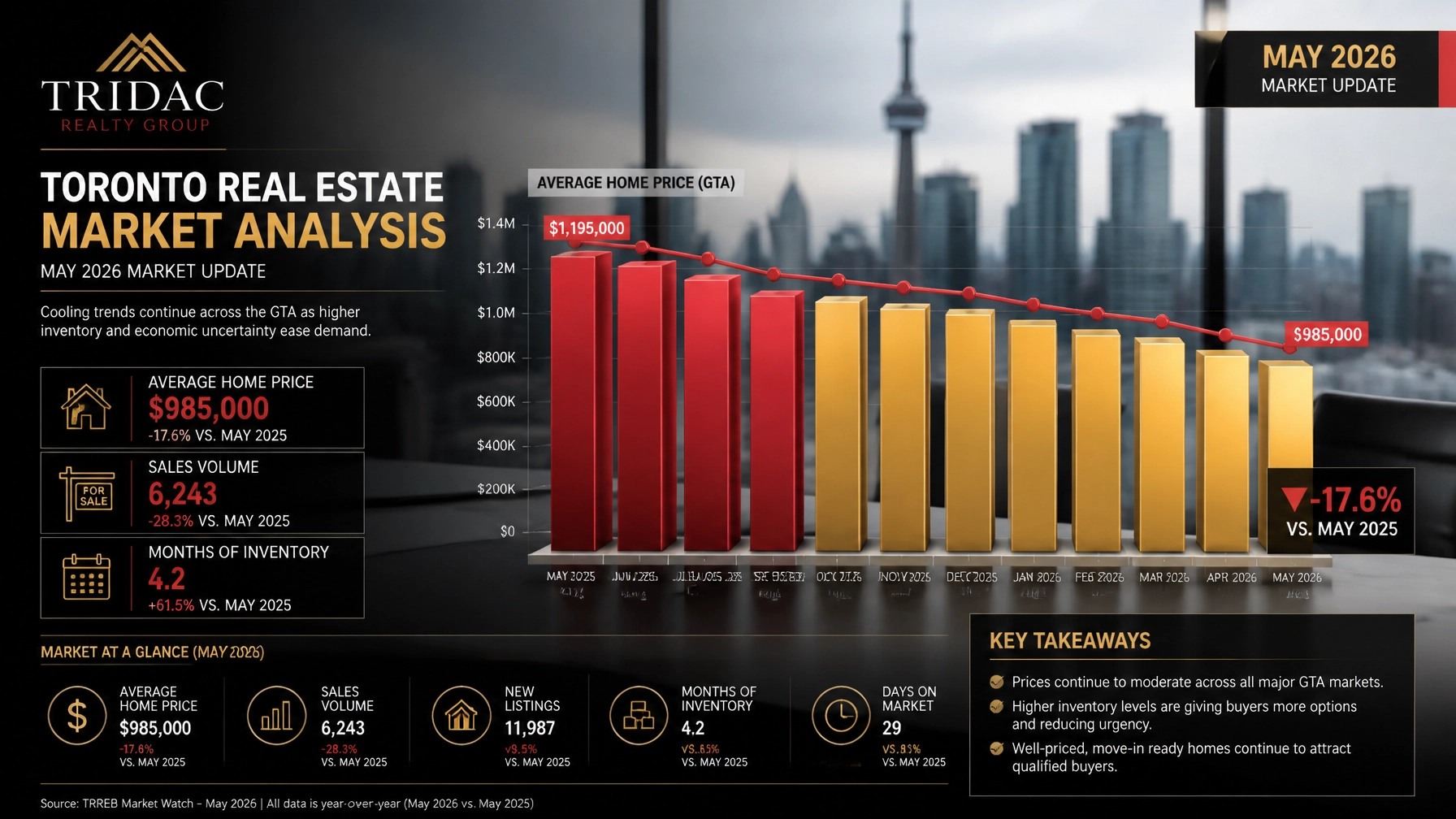
According to current market data and forecasts from TRREB and CMHC, we are seeing a period of price stabilization with a slight downward lean.
- GTA Benchmark Price (May 2026): ~$946,500 (down 6.7% YoY)
- Average Sold Price: ~$1,069,700 (down 4.6% YoY)
While some regions may see minor month-over-month fluctuations, the overall trend for 2026 is expected to remain flat. TRREB forecasts between 60,000 and 70,000 sales for the year, with average prices hovering between $1.0M and $1.03M. For a buyer, this "sideways" market is an ideal time to enter before any potential price surges caused by future interest rate cuts.
3. How much down payment do I need in Ontario in 2026?
The down payment requirements in Ontario remain tied to the purchase price of the home:
- $500,000 or less: 5% of the purchase price.
- $500,001 to $1,499,999: 5% on the first $500k and 10% on the remaining portion.
- $1,500,000 or more: A minimum of 20% is required.
Given that the average detached home in the GTA is currently sitting at $1,358,131, many buyers moving into the freehold market must prepare for that 20% threshold. However, for those looking at condos for sale in Toronto (average price ~$639,400), a much lower entry point is possible.
4. What are the current mortgage rates and how do they affect affordability?
The Bank of Canada has held its key interest rate steady at 2.25% through the first half of 2026. This has brought some much-needed predictability to the market.
- Prime Rate: 4.45%
- 5-Year Fixed Mortgage: ~4.69%
- 5-Year Variable Mortgage: ~3.55%
While rates are higher than the historic lows of 2020, they are significantly more manageable than the peaks of 2023-2024. For a standard $800,000 mortgage, every 1% drop in rates can increase your purchasing power by tens of thousands of dollars. Using a mortgage calculator is essential to see how these rates translate into monthly payments.
5. Should I buy a condo, townhouse, or detached home?
This depends on your lifestyle and investment goals. In 2026, we are seeing a divergence in performance:
- Detached Homes: These remain the "gold standard" for long-term equity. Prices are down 4.7% YoY, offering a "discount" on luxury and space.
- Townhomes: A popular "middle ground" for families. Townhomes for sale in the GTA are currently seeing the highest demand due to their relative affordability compared to detached houses.
- Condos: With prices down 6.4% YoY, the condo market offers the lowest barrier to entry. They are excellent for real estate investment in Toronto or for first-time buyers wanting to stay in the urban core.
6. What first-time home buyer incentives are available in 2026?
2026 is a landmark year for incentives. The government has introduced and expanded several programs to help with affordability:
- Ontario Enhanced HST Rebate: For new builds signed between April 1, 2026, and March 31, 2027, you could receive up to $130,000 back.
- First Home Savings Account (FHSA): You can contribute up to $8,000/year (max $40,000 total) and use it tax-free for your purchase.
- RRSP Home Buyers' Plan (HBP): The limit has been increased to $60,000 per person ($120,000 for a couple).
- 30-Year Amortization: Now available for first-time buyers on certain builds, helping to lower monthly mortgage payments.
7. What closing costs should I expect in the GTA?
Many buyers forget to budget for closing costs, which typically range from 1.5% to 4% of the purchase price. In the GTA, the largest cost is the Land Transfer Tax (LTT).
- Ontario LTT: Calculated on a sliding scale.
- Toronto MLTT: If you buy within the city of Toronto, you pay a second, municipal tax.
- Rebates: First-time buyers can get up to $4,000 back on the Ontario tax and $4,475 on the Toronto tax (a combined $8,475).
- Other Costs: Legal fees (~$1,500–$2,500), title insurance, and home inspections ($500–$800).
8. How much income do I need to buy a home in the GTA?
To pass the mortgage stress test (currently around 6.69% for fixed rates), your household income needs to be substantial.
For the average GTA home (~$1M), with a 20% down payment, a household income of approximately $180,000 to $200,000 is generally required, assuming minimal other debts. However, if you are looking at entry-level condos or properties in areas like Brampton or Georgetown, that requirement can drop significantly. My one-stop mortgage services can help you find a financing strategy tailored to your specific income level.
9. What areas offer the best value for buyers right now?
While Toronto remains the hub, growth corridors in the "905" and beyond are offering incredible value:
- Caledon: Known for its luxury estates and upcoming developments. Caledon Real Estate is perfect for families seeking space.
- Brampton: A diverse market with excellent transit links. Brampton Real Estate Market Updates show it remains a top choice for first-time buyers.
- Cambridge & Kitchener: For those willing to commute, these areas offer detached homes at a fraction of Toronto prices.
- Milton & Oakville: Consistently high-ranking for schools and community amenities.
10. Is it better to buy or rent in today’s market?
In 2026, the "buy vs. rent" debate has shifted. With rents in Toronto remaining near all-time highs and home prices stabilizing, the "cost of ownership" is becoming more comparable to the "cost of renting."
When you rent, your "return" is 0%. When you buy, even in a flat market, you are paying down your principal and building equity. With the prime rate at 4.45%, the long-term benefit of ownership far outweighs renting for those planning to stay in their home for 5+ years.
11. How do Power-of-Sale and Bank Foreclosure properties work?
We have seen a slight uptick in Power-of-Sale properties in early 2026. Unlike a traditional sale, the lender (bank) is selling the property to recoup their debt.
- The Pro: You might find a property priced slightly below market value.
- The Con: These properties are sold "as is," meaning the bank makes no guarantees about the condition of the home. Professional due diligence and a thorough home inspection are non-negotiable here.
12. What common mistakes should first-time buyers avoid?
- Skipping Pre-Approval: Don't start shopping until you know exactly what the bank will lend you.
- Ignoring the Neighborhood: A great house in the wrong area is a bad investment. Check local community guides for insights.
- Underestimating Maintenance: Owning a home comes with unexpected costs (roof leaks, furnace repairs). Ensure you have an emergency fund.
- Emotional Over-Bidding: Even in a buyer's market, it's easy to get attached. Rely on data, not feelings.
13. What are the benefits of buying Pre-Construction in 2026?
Pre-construction continues to be a favorite for investors and those who need a flexible closing timeline. I work closely with Canada's top builders, including Mattamy Homes, The Daniels Corporation, Treasure Hill, and Fieldgate Homes.
- Modern Finishes: You get the latest in energy-efficient tech and design.
- Deposit Structure: Usually 10–20% spread over several years, allowing you time to save.
- Warranty: Protected by Tarion, giving you peace of mind on your new investment.
14. What are the best opportunities for Real Estate Investment in Toronto?
Beyond residential, 2026 is seeing a surge in commercial properties in the GTA. Mixed-use developments (retail on the bottom, residential on top) are proving to be resilient assets. For those looking at residential investment, focus on "Transit-Oriented Communities" near new GO stations or Eglinton Crosstown stops.
15. What is "The PhD Advantage" and how does it help me?
Real estate is the biggest financial transaction of your life. Why settle for a "gut feeling" when you can have data-driven certainty?
My background as a PhD and Post-Doctoral Fellow (UofT) means I approach every deal with analytical precision. I don't just show you houses; I analyze market cycles, cap rates, and neighborhood growth trajectories. Combined with my one-stop real estate, mortgage, and legal solution, I ensure that your purchase is seamless from the first viewing to the final signature.
Conclusion: Your 6-12 Month Action Plan
If you are planning to buy in the next year, the current May 2026 window is your preparation phase. The market is balanced, rates are steady, and inventory is high.
- Get a detailed Home Valuation: If you are selling to buy, know your home worth now.
- Max out your Incentives: Start contributing to your FHSA and check your RRSP limits.
- Consult an Expert: Don't navigate this alone.
Ready to start your journey? Whether you are a first-time homebuyer or a seasoned investor, I am here to provide the expert guidance you deserve.
Dr. Jagmohan Sabharwal, PhD PDF(UofT) ABR® SRS RENE
Real Estate Broker
Executive Real Estate Services Ltd., Brokerage
📞 416-877-4680
🌐 www.jagmohansabharwal.ca